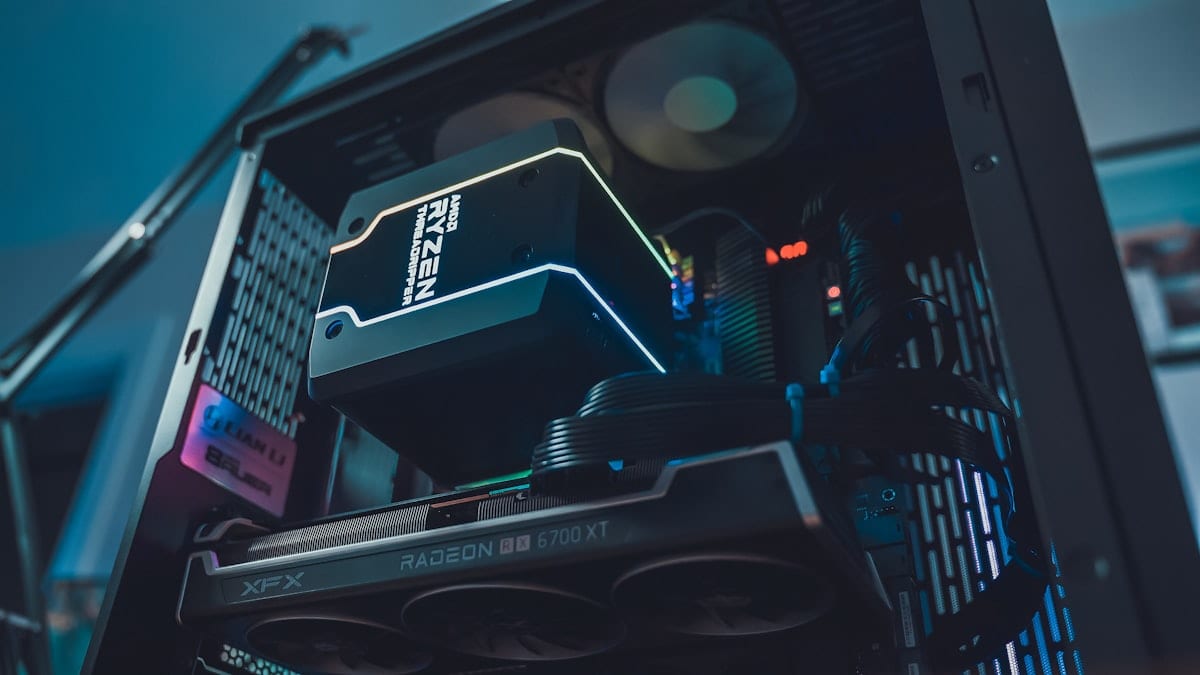
32GB is the top of the consumer stack, and what it buys is not a class of model the smaller tiers cannot touch. It is margin. The same 27B to 35B models that fit a 24GB card with a couple of gigabytes to spare run here at a higher quantisation, with a vision projector attached, or alongside a second model that stays warm.
Quick Reference
| Use Case | Best Pick | Static weights | Quantisation | Note |
|---|---|---|---|---|
| Chat | Qwen3.8-27B | 30 GB Ollama tag | Q8_0 | Apache 2.0; about 4.06 GiB left |
| Chat (long context) | Qwen3.8-27B | 18 GB Ollama tag | Q4_K_M | About 15.24 GiB left, room for a 128K-token cache |
| Chat (MIT alternative) | GLM-4.7-Flash | 19 GB Ollama tag | Q4_K_M | Q8_0 is 32GB, about 2.20 GiB left |
| Chat (MoE speed) | Qwen3.6-35B-A3B | 23 GB Ollama tag | Q4-class | Full 262,144-token window needs 5 GiB of cache and fits |
| Coding (autocomplete) | Qwen2.5-Coder 32B | 26.89 GB | Q6_K | FIM, about 6.96 GiB left |
| Coding (agentic) | Qwen3.8-27B | 21.98 GB | UD-Q6_K | About 11.53 GiB left; Q8_0 (29.05 GB) leaves 4.95 GiB |
| Coding (MoE alt) | KAT-Coder-V2.5-Dev | 27.99 GiB | Q6_K (community) | Apache-2.0, 35B total / 3B active; about 4.01 GiB left |
| Translation | TranslateGemma 27B + Qwen3.5-9B | 17 + 5.68 GB | Ollama build + Q4_K_M | 22.68 GB together, about 10.9 GiB left; Gemma terms on the 27B |
| Vision (default) | Qwen3.8-27B + mmproj | 22.91 GB | UD-Q6_K + mmproj-F16 | About 10.7 GiB left for context and images |
| Vision (max precision) | Qwen3.8-27B + mmproj | 29.97 GB | Q8_0 + mmproj-F16 | About 4.1 GiB left |
| Vision (speed) | Gemma 4 26B-A4B + mmproj | 18.14 GB | UD-Q4_K_M + mmproj-F16 | MoE, about 15.1 GiB left |
| Speech | Canary-Qwen + Ming-3.0-tts-0.5B + chat model | 8.08 GB speech weights | mixed | MIT TTS, no non-commercial licence in the speech stack |
| Agents | GLM-4.7-Flash | 19 GB | Q4_K_M | MIT licence |
Updated November 2026.
Local AI by VRAM Tier - 8GB | 12GB | 16GB | 24GB | 32GB
Deep dives: Chat | Coding | Translation | Vision | Speech | Agents | Reasoning | Image generation | Video generation | Embeddings and rerankers | RAG
November 2026 refresh: Qwen3.8-27B (Apache 2.0, published on Hugging Face in August) is now the chat pick at Q8_0, the agentic coding pick at Q6_K and the vision pick, with GLM-4.7-Flash moving to the MIT chat alternative and Gemma 4 26B-A4B to the vision speed pick. Translation reflects TranslateGemma’s 2K-token input context. The text-to-speech pick moves to Ming-3.0-tts-0.5B (MIT), because Step-Audio-EditX’s Apache 2.0 grant covers its code, not its weights. GPU-throughput and street-price figures that traced to aggregator blog posts were removed in August and stay out.
Your Hardware
32GB of VRAM on a single consumer card means the RTX 5090, which is the only card in that class. Availability and pricing on it move constantly, so check current listings rather than a number written months ago.
How to read the VRAM numbers on this page. Every figure is the static size of the model weights at the named quantisation, taken from published GGUF file sizes, with two exceptions that are labelled where they appear: the Whisper figures are OpenAI’s own required-VRAM numbers rather than weight sizes, and the Step-Audio-EditX figures are StepFun’s stated GPU memory rather than weight sizes. The KV cache is allocated on top and grows with context length, so each number is a floor, not a total. Anything within 1-2GB of the 32GB ceiling fits with minimal context room, and that is flagged where it happens. Card memory is binary: a 32GB card holds 32 GiB, which is 34.36 GB in the decimal units file sizes use, so free-memory figures here are worked out in GiB, and the KV cache and runtime overhead come out of that remainder.
The rough math: at Q4_K_M, 32GB holds the 27-35B class with several gigabytes free for context or a second resident model. At Q6_K a 27B fits with real headroom. At Q8_0 a 27B fits with about 4 to 5 GiB to spare (Qwen3.8-27B: 4.06 GiB on the Ollama tag, 4.95 GiB on the GGUF file). Mixture-of-experts models do not help with capacity, only speed: all experts stay resident even though only a few activate per token.
No tokens-per-second figures appear on this page. Earlier versions quoted an average inference throughput and a percentage speedup over the previous card generation, both taken from GPU-benchmark blog posts this site no longer cites. No primary measurement replaced them, so those claims are gone rather than reattributed to something else. Throughput depends on the runtime, the quantisation, the context length and the batch size, so measure it on your own card.
No card at this tier? Two routes: rent a cloud GPU by the hour to try these models before buying hardware, or use a hosted service; the tool directory compares hosted options by task. For smaller cards, see Local AI by VRAM. To check a specific card against a specific build, the VRAM calculator shows which model builds fit a given card from their file sizes.
Chat & General Assistant
The chat pick at this tier is Qwen3.8-27B, the same model the 24GB tier runs, with the extra memory spent on precision or context. It is Apache-2.0 and ungated, takes image and video input, and its card compares it directly with Qwen3.6-27B (vendor-reported): IFBench 79.5 vs 69.1, GPQA Diamond 89.2 vs 87.8, HLE 30.8 vs 24.0. The qwen3.8:27b-q8_0 tag on Ollama is 30GB (about 27.94 GiB) and leaves about 4.06 GiB, enough for 32K tokens of context (2 GiB at 64 KiB per token). At Q4_K_M (18GB) the same model leaves about 15.24 GiB, which holds a 128K-token cache (8 GiB) comfortably; the full 262,144-token native window would need 16 GiB of cache at 16-bit, which does not fit. Thinking mode is on by default and, per the card, “can be disabled per request”.
MIT alternative: GLM-4.7-Flash, a 30B-total / 3B-active mixture-of-experts model under an MIT licence. Its Ollama Q4_K_M tag is 19GB, which also fits a 24GB card; the Q8_0 tag is 32GB, which leaves only about 2.20 GiB here. The BF16 tag is 60GB and does not fit. Its card lists AIME 25 at 91.6 and GPQA at 75.2 (vendor-reported); the same table lists GPT-OSS-20B at 91.7 and 71.5, so the reasoning lead over the 16GB chat pick is small.
Speed alternative: Qwen3.6-35B-A3B computes with 3B of its 35B parameters per token and has a small KV cache, 20 KiB per token (10 full-attention layers with 2 KV heads), so its full 262,144-token window needs 5 GiB on top of the 23GB tag. That fits in the about 10.58 GiB left on a 32GB card.
Full comparison: local chat model guide.
Coding
Agentic: Qwen3.8-27B. It fits at UD-Q6_K (21,980,441,504 bytes, 20.47 GiB, 11.53 GiB free) or Q8_0 (29,047,086,048 bytes, 27.05 GiB, 4.95 GiB free); Q6_K leaves the more useful context headroom. Qwen does not publish a SWE-bench Verified figure for it; on its own model card it reports 61.7% on SWE-bench Pro against 53.5% for Qwen3.6-27B, run on Qwen’s own harness. Qwen3.6-27B, the previous pick, carries a Qwen-reported 77.2% SWE-bench Verified, a different benchmark that cannot be set against the SWE-bench Pro figure.
Autocomplete: Qwen2.5-Coder 32B at Q6_K, 26,886,154,432 bytes (25.04 GiB, 6.96 GiB free), the higher-precision build a 24GB card cannot hold. The Qwen team’s own technical report reports 92.7% HumanEval for the 32B instruct model. It is an older generation than everything else on this page and still the strongest dedicated fill-in-the-middle model in this lineup. At Q4_K_M it is 19,851,335,872 bytes (18.49 GiB). Autocomplete and agentic models still take turns: the Q4_K_M coder plus Qwen3.8-27B at UD-Q4_K_M (15.43 GiB) is about 33.9 GiB, over the card.
Apache-licensed alternatives: Kwaipilot KAT-Coder-V2.5-Dev, a 35B-total / 3B-active mixture-of-experts model under Apache-2.0 with a native 262,144-token context, runs here at bartowski’s community Q6_K build (27.99 GiB, 4.01 GiB free), a higher quant than a 24GB card allows. Kwaipilot’s self-reported scores include SWE-bench Verified 69.40% and SWE-bench Pro 45.96%; those are different benchmarks over different task sets, so reading one against the other as a decline is a mistake. Devstral Small 2, a 24B dense Apache-2.0 model (68.0% SWE-bench Verified per Mistral), fits at Q8_0 (25,055,317,152 bytes, 23.33 GiB, 8.67 GiB free). Mistral’s docs mark it deprecated as of 27 February 2026 and point new integrations at Mistral Medium 3.5, whose roughly 128B open weights are far beyond a single consumer GPU; the Apache-2.0 Devstral weights stay downloadable and keep working.
The stretch that does not fit: Qwen3-Coder-Next, an 80B / 3B-active MoE under Apache 2.0, is 48,528,320,544 bytes (45.20 GiB) at Q4_K_M in Unsloth’s build, so a single 32GB card has to offload more than a quarter of the weights to system RAM.
Full comparison: local coding model guide.
Translation
TranslateGemma 27B is listed on Ollama at 17GB, and at this tier it no longer has to take the card to itself. TranslateGemma 27B plus Qwen3.5-9B at Q4_K_M (5.68GB) is 22.68GB of weights combined (21.12 GiB), leaving about 10.9 GiB for the general model’s context: route literal and technical pairs to the dedicated translator and prose to the general model. Its technical report puts it at MetricX 3.09 and COMET22 84.4, figures published by the model’s own authors. Its model card gives a “Total input context of 2K tokens”, so long texts go through in segments. The licence is Google’s custom Gemma terms with a prohibited-use policy attached, not a blanket open licence.
Ollama also publishes higher-precision TranslateGemma 27B builds alongside the 17GB default: a q8_0 tag at 30GB (about 27.94 GiB), which fits this card on its own with about 4.1 GiB left, enough for the 2K-token inputs but no room for a second model, and a bf16 tag at 55GB that does not fit at all. The Q6_K TranslateGemma figure that used to appear on this page has no primary source behind it and has been removed.
Single-model maximum: Qwen3.5-27B at Q6_K, 22.45GB (20.91 GiB, about 11.1 GiB free), Apache-2.0, and the widest claimed language list of anything that fits one card: Qwen’s 201-language figure is on the Qwen3.5 model cards. The Qwen3.8-27B equivalent, Unsloth’s UD-Q6_K, is 21.98GB (20.47 GiB); its card states no language count and publishes no translation benchmark.
Full comparison: local translation model guide.
Vision
Nothing new in the Qwen line becomes available at 32GB; what changes is that the 24GB options stop being tight. Every figure below is static weights plus the F16 vision projector and excludes the KV cache, which on a vision model grows with image resolution as well as context length.
| Option | Quantisation | Weights + mmproj | Free before KV cache |
|---|---|---|---|
| Qwen3.8-27B | UD-Q6_K + mmproj-F16 | 21.98 + 0.93 = 22.91 GB (21.33 GiB) | about 10.7 GiB |
| Qwen3.8-27B | Q8_0 + mmproj-F16 | 29.05 + 0.93 = 29.97 GB (27.92 GiB) | about 4.1 GiB |
| Gemma 4 26B-A4B | UD-Q4_K_M + mmproj-F16 | 16.95 + 1.19 = 18.14 GB (16.89 GiB) | about 15.1 GiB |
| Gemma 4 31B | Q6_K + mmproj-F16 | 26.40 GB (24.59 GiB) | about 7.4 GiB |
The working default is Qwen3.8-27B at Q6_K. It carries the strongest self-reported vision numbers of any Qwen model that fits a single consumer card, ahead of Qwen3.6-27B on every row of Alibaba’s VL table (for example OmniDocBench 1.5 91.1 against 89.4, CharXiv RQ 83.7 against 78.4). The same 22.91GB configuration on a 24GB card leaves about 2.7 GiB; here it leaves about 10.7 GiB, which is the difference between a demo and a working pipeline.
Q8_0 is a hedge, not a measured gain. No benchmark comparison between Q6_K and Q8_0 builds of this model was found, so treat the extra precision as insurance against quantisation artifacts on dense small text rather than as a known improvement, and note that it leaves about 4.1 GiB.
MoE speed pick: Gemma 4 26B-A4B. Google’s card lists 25.2B total and 3.8B active parameters, so it runs much faster than its total size suggests, and at 18.14GB it leaves about 15.1 GiB here. In Google’s own table it sits below the 31B on all three vision benchmarks it reports (MMMU Pro 73.8% against 76.9%). Gemma 4 31B at Q6_K plus projector also opens up at this tier; its Q8_0 weights alone, 32.64GB, do not fit.
All of these figures are vendor self-reported, and Alibaba and Google use different benchmark sets and harnesses, so their numbers are not a like-for-like comparison. Alibaba publishes no official GGUF for Qwen3.5, Qwen3.6 or Qwen3.8; the sizes above are Unsloth’s conversions. For a Qwen mixture-of-experts model, read llama.cpp issue #25717 first: the reported Qwen3.5-35B-A3B vision crash with mmproj and flash attention was closed on 2026-08-30 by the repository’s automation bot as not_planned, with no fix referenced.
Multi-model stack. 32GB also holds vision, chat and speech at once. Qwen3.5-9B at Q4_K_M plus its 0.92GB projector is 6.60GB, which leaves more than 24 GiB for a chat model and a speech pair.
Full comparison: local vision model guide.
Speech
32GB runs a full-quality voice pipeline with a capable conversational model behind it. Transcription: Canary-Qwen-2.5B at 5.12GB of bf16 weights for English (NVIDIA publishes no VRAM figure), Parakeet TDT 0.6B v3 for the smallest footprint (a 2.51 GB fp32 file; its card says “At least 2GB RAM for model to load”), or Whisper large-v3, at OpenAI’s ~10 GB required-VRAM figure, for its 99 languages. No accuracy ranking between them is restated: the live Open ASR leaderboard order could not be reconfirmed, so the ranking and the word-error-rate comparison that used to appear across this series have been removed rather than repeated. If you run whisper.cpp, it is at v1.9.5 (2026-10-06); v1.9.0 added NVIDIA Parakeet support, so one runtime covers both families.
Text-to-speech, with a correction. On the Artificial Analysis open-weights TTS board read 2026-11-16, Fish Audio Drama 3 is first at 1277 Elo, while Fish Audio S2 Pro is sixth at 1104 and Step-Audio-EditX seventh at 1100. This page previously recommended Step-Audio-EditX as Apache-2.0, but StepFun’s README grants Apache 2.0 for “the code in this open-source repository”; the weights repository states no licence.
The pick is now Ming-3.0-tts-0.5B (MIT), fourth on the board at 1183 and the highest-placed model there that Artificial Analysis flags as commercially usable. It publishes no VRAM figure; its weights file is 2.96 GB.
Best combination here: Canary-Qwen (5.12GB) plus Ming-3.0-tts (2.96GB) is 8.08GB of speech weights, which leaves most of a card that holds 32 GiB (34.36 GB) for a conversational model, with no non-commercial licence in the speech stack. Step-Audio-EditX remains the option for its editing workflow: StepFun gives 12 GB as a minimum and says 16 GB is safer, and its weights licence is unresolved. Fish Audio S2 Pro (10.99 GB of weight files) is non-commercial. The Drama 3 int4 build’s 22.3 GiB of files would leave about 9.7 GiB of this card, but the only published hardware for it is a data-centre GPU.
Full comparison: local speech model guide.
Agents
GLM-4.7-Flash is the 32GB agent pick: the same 30B-total / 3B-active mixture-of-experts model as the chat section, under an MIT licence, with enough KV-cache headroom here to hold a long tool history without eviction. The mixture-of-experts design matters for agents specifically, because every tool call is a round trip and a ten-step workflow means ten or more inference passes.
When the priority is clean, parseable function calls rather than long autonomous planning, the Qwen dense line is the alternative: Qwen3.8-27B, the chat and coding pick here, runs at this tier with a higher quantisation or a very large context. The agent deep dive carries the function-calling numbers for both, with the warning that they come from different benchmarks and are not directly comparable.
Full comparison: local agent model guide.
Getting Started
# Install Ollama
curl -fsSL https://ollama.com/install.sh | sh

# The essentials for 32GB
ollama pull qwen3.8:27b-q8_0       # Chat + agentic coding (30GB)
ollama pull glm-4.7-flash          # Agents, MIT (19GB)
ollama pull qwen2.5-coder:32b      # Autocomplete
ollama pull translategemma:27b     # Translation (17GB)

# These do not all fit at once; Ollama loads and unloads as needed
ollama run qwen3.8:27b-q8_0
Model tags shift as libraries update, so check the Ollama library for current ones. Ollama’s qwen3.8 tags take text and image input. For GGUF files outside Ollama, there is no official Alibaba GGUF for Qwen3.8, so you are pulling a community conversion.
The 32GB Advantage: Margin, Not New Categories
Nothing on this page is a model class the 24GB tier cannot touch. What changes is how much room is left after the weights load:
- Qwen3.8-27B at UD-Q6_K plus its vision projector (22.91GB) leaves about 10.7 GiB here against about 2.7 GiB on a 24GB card
- Qwen3.8-27B at Q8_0 fits for chat and coding, which a 24GB card cannot hold
- Qwen2.5-Coder 32B at Q6_K (26.89GB) replaces the Q4 build for autocomplete at a higher precision
- A dedicated translator and a general model stay resident together at 22.68GB instead of taking turns
- A full voice pipeline (Canary-Qwen plus Ming-3.0-tts, 8.08GB of weights) leaves most of the card for a chat model
- KAT-Coder-V2.5-Dev runs at Q6_K (27.99 GiB), a higher quant than a 24GB card allows
Every total above is static weights at the named quantisation. Leave headroom on whichever model does the long-context work.
What 32GB Does Not Buy
It does not buy the frontier. The open-weight models topping the mid-2026 leaderboards run to hundreds of billions of parameters: even the smallest current build of DeepSeek V4, the V4-Flash-0731 beta, lands around 82.5GB as a 1-bit community quantisation, and the larger releases run from hundreds of gigabytes into the terabytes. Those are server models, and the chat guide covers them with their licences and runtime status.
It also does not buy a large jump in quality over 24GB. The model list is nearly identical between the two tiers; what differs is the quantisation you run it at and how many models stay warm at once. If a 24GB card is already in the machine, it covers most of this page with tighter margins. The case for 32GB is document-grade vision at Q6 with real context, near-lossless autocomplete, and multi-model pipelines that never have to swap.
All eleven local-AI guides, by hardware tier and by task, are indexed at Local AI by VRAM: Which Models Fit Your GPU.